Causely Feature Demo: Diagnosing Failures in an Agentic App
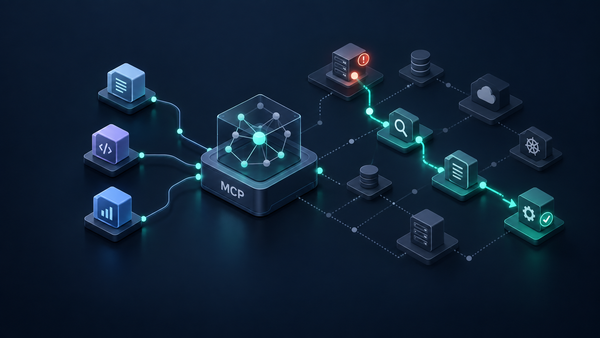
Causely maps an agentic app's agent sessions, MCP tools and services, then traces failed runs to the cause: a broken tool contract or an MCP server exception.

An agentic app adds new places for a failure to start. The agent calls tools on an MCP server, each tool calls services, and those services call databases. When a run fails, the agent reports a schema error or a failed session. The cause can sit in a tool's response contract, in the MCP server's code, in a service, or in the infrastructure. Each layer shows a different symptom, and none of them names the cause.
Causely maps the whole app automatically: infrastructure, services, the request flow between them, and the agent's activity. Every agent session is linked to the tools it called, and every tool to the service behind it. Causely builds a causal model on top of that topology and reasons from the symptoms to the root cause.
We ran this on Robot Shop with an agentic shopping assistant. Each run searches the catalog, compares two robots, adds one to the cart and verifies the cart, through a real agent framework, an MCP server, and the services and databases behind it. Then we injected two failures. Both look the same from the agent's side. They start in different layers.
| Fault injected | Layer | What the agent saw | Causely's diagnosis |
|---|---|---|---|
search_products returns price as text | Tool contract | Every run fails (schema error) | MCP tool contract violation on search_products |
| Unhandled Python exception on every request | MCP server code | Every run fails | Unhandled Python exception in shop-mcp |
The contract failure is the harder one to spot, because the MCP server still reports success. Causely reached each diagnosis within a few minutes. For the tool fault, the evidence clears the agent and the infrastructure. For the server fault, it ties the exception in the server's logs to error signals on shop-mcp and failed sessions on shopping-load. The causal view traces each fault to every agent session and request path it breaks, with a probability on each link in the causal chain.
In production, thousands of agents and apps call one MCP server that exposes many tools, with services, databases and infrastructure behind them. A failure can start in any of those layers. Causely connects the symptoms back to the one cause behind them.
Watch the video to see both failures diagnosed in Robot Shop. To see how Causely covers AI workloads, read Observe AI Workloads. For results across agents and scenarios, see the Causely benchmark.